
Class 4 Prepositions vs Adverbs Worksheet

Class 4 Prepositions vs Adverbs Worksheet
Words That Move and Words That Connect: Prepositions and Adverbs Worksheet for Class 4
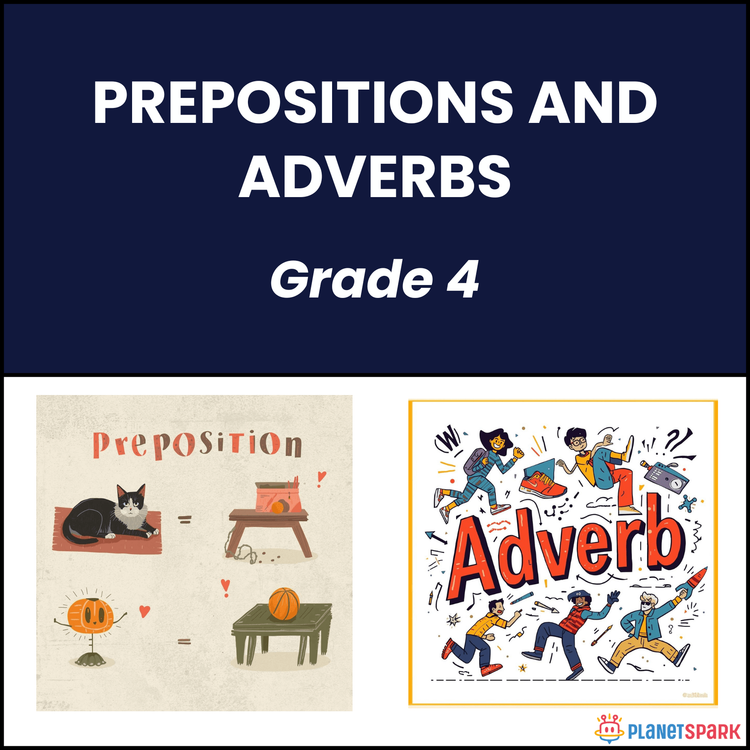
This Grade 4 worksheet on Prepositions and Adverbs is a rich and well-structured grammar resource that helps young learners understand two of the most frequently used — and often confused — word types in English. Designed specifically for Class 4 students, this worksheet teaches children the key difference between prepositions, which show the relationship between a noun and another word in the sentence, and adverbs, which describe or modify verbs, adjectives, or other adverbs. Words like over, under, through, before, near, and inside are explored as prepositions, while words like quickly, beautifully, softly, fast, and early are explored as adverbs. Through five progressively challenging exercises, students move from selecting the correct word in multiple choice questions all the way to applying both word types independently in a paragraph writing task.
Why Do Prepositions and Adverbs Matter in Grammar?
Prepositions and adverbs are essential grammar concepts for Grade 4 learners because:
1. They are used in almost every sentence in English and play a crucial role in making meaning clear — telling readers where something is, when it happens, and how it is done.
2. Confusing a preposition with an adverb — for example, writing "he jumped quickly the fence" instead of "he jumped over the fence" — is a very common error that weakens the quality of student writing.
3. Learning to distinguish between the two builds stronger sentence construction skills, which directly improves composition and comprehension performance.
4. Both word types appear consistently in school grammar exams, fill-in-the-blank exercises, and writing tasks throughout the primary years.
What's Inside This Worksheet?
This worksheet includes five carefully designed exercises that build students' understanding and application of prepositions and adverbs from multiple choice identification all the way to paragraph completion:
Exercise 1 – Multiple Choice Questions
Students choose the correct preposition or adverb from three options to complete each sentence. The sentences feature familiar characters and everyday situations — cats jumping over walls, birds flying above clouds, and children running in parks — making the grammar relatable and easy to engage with.
Exercise 2 – Fill in the Blanks
Students choose the correct word from a given pair of options to fill each blank. Each pair contains one preposition and one adverb, and the sentence context makes it clear which type of word is needed. This exercise sharpens students' ability to distinguish between the two word types in practice.
Exercise 3 – Match the Following
Students match each sentence to the correct preposition or adverb from a list on the right. Words to match include quickly, before, around, inside, near, up, down, after, slowly, and over. This exercise builds recognition of how each word functions within a sentence context.
Exercise 4 – Underline the Incorrect Word
Students read each sentence and underline the incorrect preposition or adverb that has been used. This error-correction activity trains students to identify and fix grammar mistakes — an important skill for both exam writing and everyday composition.
Exercise 5 – Paragraph Writing
Students complete a descriptive paragraph set on a rainy morning in Mumbai by filling in blanks with suitable prepositions or adverbs. The paragraph follows a school day scenario involving characters Rohan, Diya, and Arjun, giving students a rich, real-world context in which to apply everything they have learned across the worksheet.
Answer Key (For Parents & Educators)
Exercise 1 – Multiple Choice Questions
1. b) over
2. b) quickly
3. c) above
4. a) very
5. c) under
6. b) beautifully
7. a) early
8. c) through
9. b) fast
10. a) quickly
Exercise 2 – Fill in the Blanks
1. down
2. outside
3. until
4. fast
5. on
6. before
7. through
8. softly
9. near
10. well
Exercise 3 – Match the Following (Possible answers)
1. The car drove __________ the bridge. → over, around, up, down, near
2. They walked __________ the park. → around, near, before, after, inside
3. Climb __________ to see the view. → up, down, quickly, slowly
4. The stone rolled __________ the hill. → down, near
5. He spoke __________ to be heard. → slowly, quickly
6. She ran __________ to catch the bus. → quickly
7. We rested __________ the match. → after, after
8. Reach school __________ 8 am. → before, after
9. Stand __________ the stage. → near
10. They hid __________ the house. → inside
Exercise 4 – Underline the Incorrect Preposition or Adverb
1. on (correct word: early)
2. quickly (correct word: over)
3. happily (correct word: on)
4. nearly (correct word: near / beside)
5. under (correct word: beautifully)
6. before (correct word: happily / quickly)
7. above (correct word: in)
8. happily (correct word: up)
9. at (correct word: in)
10. across (correct word: beside / next to)
Exercise 5 – Paragraph Writing (Sample Answers)
On a rainy morning in Mumbai, Rohan walked through the school gate and stood near his friends. He kept his bag on the bench and looked around for the teacher. When the bell rang, the class moved along the corridor and settled quietly. The teacher spoke softly and asked the children to sit at their desks. During recess, they ran across the playground, but Diya waited outside because the floor was wet. After lunch, everyone returned to the classroom and worked hard on the worksheet. Later, Arjun carefully placed his notebook on the shelf and wrote neatly in neat letters. The rain stopped, so the children walked quickly to the bus and waved cheerfully to the guard.
Help your child master prepositions and adverbs and write with greater precision — book a Free 1:1 English Grammar Trial Class at PlanetSpark and build the grammar skills that make every sentence shine!
Frequently Asked Questions
Prepositions show the relationship between a noun and another word, while adverbs describe how, when, or where an action happens in a sentence.
Children often get confused because some words like inside or above can act as both, depending on whether they are followed by a noun.
Parents can encourage sentence-building practice and help children identify whether a word connects to a noun or describes a verb.