
Class 6 Worksheet on Synthesizing Ideas from Texts

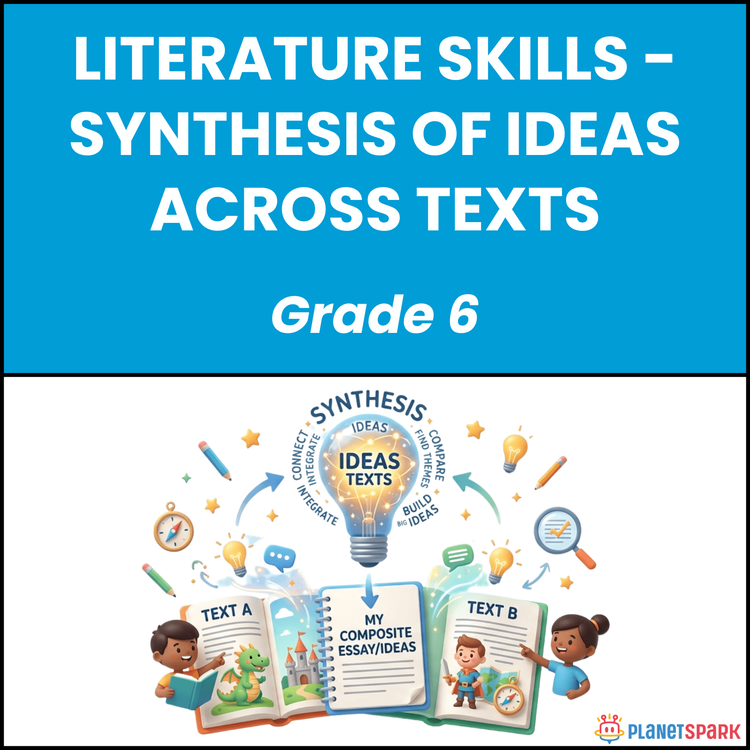
Class 6 Worksheet on Synthesizing Ideas from Texts
Synthesis Architect: Finding Invisible Threads Across Different Texts for Grade 6
This Grade 6 literary analysis worksheet teaches students how to synthesize ideas across seemingly unrelated texts. Using the original story "The Shared Lens," students follow Siddharth as he compares two scientific articles — one about harvester ants and another about honeybees — and discovers hidden connections about collective intelligence, efficiency, and nature's blueprint of teamwork and math. Task types include multiple-choice questions, fill-in-the-blanks (with a word bank), true/false corrections, sentence-based vocabulary selection, and a short paragraph writing exercise that asks students to synthesize the common ideas between the ant and bee articles. This worksheet builds essential skills for writing synthesis essays — a higher-order thinking skill required for advanced middle school and high school English.
Why Is Synthesis of Ideas Across Texts Important in Literary Studies?
Synthesis goes beyond summarizing individual texts — it finds meaningful connections and patterns across them. For Grade 6 learners, learning to synthesize is important because:
1. It teaches students to look for underlying themes, structures, and ideas that connect different subjects.
2. It builds the skill of finding "invisible threads" that tie different worlds together.
3. It prepares students for research-based writing where multiple sources must be combined.
4. It develops critical thinking by asking "What do these different things share beneath the surface?"
What's Inside This Worksheet?
This worksheet includes five literature-based activities that strengthen synthesis writing skills:
🧠 Exercise 1 – Multiple Choice Questions (Story Recall)
Students answer 10 questions based directly on "The Shared Lens," testing memory of characters, article topics, and key insights. Example: "Where did Siddharth sit for his project?" (In Bengaluru)
✏️ Exercise 2 – Fill in the Blanks (with Word Bank)
Students complete 10 sentences using keywords from a provided word bank, reinforcing vocabulary and main ideas. Example: "Siddharth completed his ______ at a desk." (project)
✅ Exercise 3 – True and False (with Correction)
Students read 10 statements and mark them true or false. Each false statement must be corrected using story details, promoting careful reading. (This worksheet has 5 true and 5 false statements.)
📖 Exercise 4 – Underline the Correct Word
Students choose the correct word from three options to complete each sentence accurately based on the story. Example: "He read articles a (first / second / third) time."
📝 Exercise 5 – Paragraph Writing (Synthesis)
Students write a 60–80 word paragraph synthesizing the common ideas between the ant and bee articles that Siddharth discovered. This directly builds synthesis essay writing skills.
✅ Answer Key (For Parents & Educators)
Exercise 1 – Multiple Choice Questions
1. b) In Bengaluru
2. a) Harvester ants
3. a) Bee hives (the article described honeycombs in hives)
4. c) Factory chimneys (chimneys of a factory)
5. b) Wax
6. a) Measurements
7. a) Collective intelligence
8. b) The plan
9. c) Teamwork and math (blueprint of teamwork and math)
10. c) Invisible threads
Exercise 2 – Fill in the Blanks (Word Bank)
1. project
2. harvester
3. hexagons / material (either accepted; honeycombs/bees context fits)
4. chimneys
5. wax
6. analogies
7. accidental
8. plan
9. organized
10. threads
Exercise 3 – True and False (with Corrections)
Statement 1: True
Statement 2: False → Siddharth sat at his desk in Bengaluru (not Mumbai).
Statement 3: False → The second article described honeybees and honeycombs (not spider webs).
Statement 4: True
Statement 5: True
Statement 6: False → Both authors used precise measurements (millimeters and degrees) — they did not avoid them.
Statement 7: True
Statement 8: False → No single insect knew the whole plan (not that a single insect knew it).
Statement 9: False → Both articles showed nature is calculated, organized, and not accidental (the opposite of accidental).
Statement 10: True
Exercise 4 – Underline the Correct Word
1. second
2. dark
3. bright
4. hidden
5. communicate
6. dry
7. weight
8. teamwork
9. organized
10. different
Exercise 5 – Paragraph Writing (Synthesis - Sample Answer)
Siddharth discovered three common ideas between the ant and bee articles. First, both authors used technical analogies — ants' tunnels were compared to factory chimneys, and bees' hives to a high-tech storage warehouse. Second, both texts focused on efficiency: ants organized chambers to keep seeds dry, and bees chose hexagons because that shape uses the least wax to hold the most weight. Third and most importantly, both demonstrated collective intelligence — no single insect knew the whole plan, yet the group worked as one mind. Whether in dirt or air, nature follows a blueprint of teamwork and math.
Help your child master synthesis writing and cross-textual analysis with a Free 1:1 Communication Skills Trial Class at PlanetSpark.
Frequently Asked Questions
Synthesizing ideas involves combining information from different sources to form a new understanding or perspective.
By comparing and contrasting information from various texts and then writing a cohesive response that incorporates ideas from all of them.
It helps students integrate different viewpoints and create a deeper understanding of the topic being discussed.