
Class 3 Simple Future Tense English Worksheet

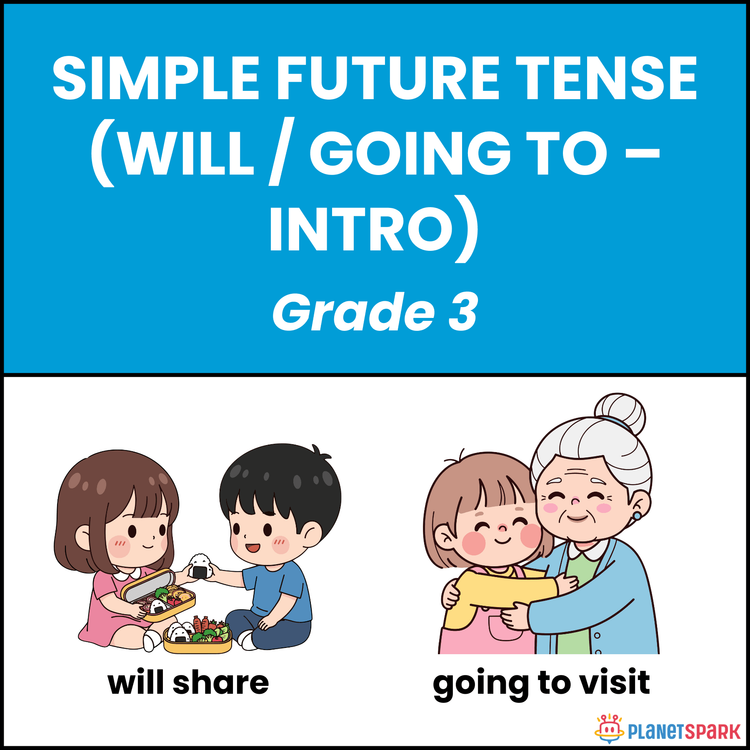
Class 3 Simple Future Tense English Worksheet
Future Ready: Mastering Simple Future Tense (Will / Going To) for Grade 3
This Grade 3 worksheet introduces young learners to the Simple Future Tense using “will” and “going to” in a clear and engaging way. Designed especially for primary students, this resource helps children understand how to talk about future plans, instant decisions, and predictions with confidence.
In this worksheet, students explore the topic Simple Future Tense (will / going to – intro) through a variety of structured grammar activities that strengthen sentence formation and verb usage.
Why Simple Future Tense Matters in Grammar?
Understanding the future tense is important because:
1. It helps students talk about upcoming events and plans clearly.
2. It builds awareness of the difference between instant decisions (will) and planned actions (going to).
3. It improves sentence structure and verb accuracy.
4. It prepares learners for advanced tenses in higher grades.
What’s Inside This Worksheet?
This worksheet includes five grammar-focused exercises to help students confidently use “will” and “going to”:
Exercise 1 – Multiple Choice Questions
Students choose the sentence that is in simple future tense. They identify correct future tense forms among present and past tense options.
Exercise 2 – True or False
Students read sentences and tick T if the sentence is in correct simple future tense, and F if it is incorrect. This improves grammar accuracy and error detection skills.
Exercise 3 – Fill in the Blanks
Students complete sentences using “will” for instant decisions and “going to” for planned actions along with the correct verb form.
Exercise 4 – Sentence Rewriting
Students rewrite given sentences by changing them into simple future tense using “will” or “going to.”
Exercise 5 – Paragraph Writing (Guided Fill-in)
Students read a fun passage about a zoo trip and complete the blanks using “will” or “is/am/are going to” along with suitable verbs from the given box. This activity strengthens contextual understanding and real-life usage.
This worksheet builds strong grammar foundations while keeping learning interactive and age-appropriate for Grade 3 learners.
Answer Key (For Parents & Educators)
Exercise 1 – Multiple Choice Questions
1. b) Riya will brush her hair.
2. a) Ravi will drink water after the play.
3. a) They will fly a kite.
4. b) Asha is going to drink milk later.
5. b) The train is going to arrive at noon.
6. a) We are going to plant trees.
7. b) Raj will fold the blanket nicely.
8. a) I am going to draw a rangoli.
9. a) The monkey will climb the tree quickly.
10. b) The nurse is going to check patients carefully.
Exercise 2 – True or False
1. T
2. F
3. T
4. T
5. F
6. T
7. T
8. F
9. F
10. F
Exercise 3 – Fill in the Blanks
1. will win
2. will finish
3. will rain
4. is going to mend
5. going to feed
6. is going to learn
7. will write
8. is going to buy
9. will run
10. are going to explore
Exercise 4 – Sentence Rewriting (Simple Future Tense)
1. Meera will help me with my homework.
2. They are going to visit the zoo tomorrow.
3. I will bring my notebook from home.
4. They are going to visit the library on Monday.
5. I will help you with your project.
6. The bird will sing at dawn.
7. I will wash my bottle after class.
8. We are going to climb the hill this Sunday.
9. The driver will start the engine.
10. Asha is going to share her crayons later.
Exercise 5 – Paragraph Writing
1. will be
2. am going to wear
3. is going to bring
4. will make
5. will hand out
6. will buy
7. will have
8. are going to visit
9. will feel
10. is going to share
11. will let
12. will pick
13. will tell
Help your child confidently talk about future plans and predictions with structured grammar practice designed for real understanding and fluency.
Frequently Asked Questions
“Will” is used to talk about future actions or decisions, such as “I will help you,” a key concept in Class 3 English grammar.
“Will” is often used for quick decisions, while “going to” is used for planned actions, helping students understand basic future forms clearly.
They can write five sentences about tomorrow’s plans using “will” or “going to” to reinforce grammar worksheet learning.